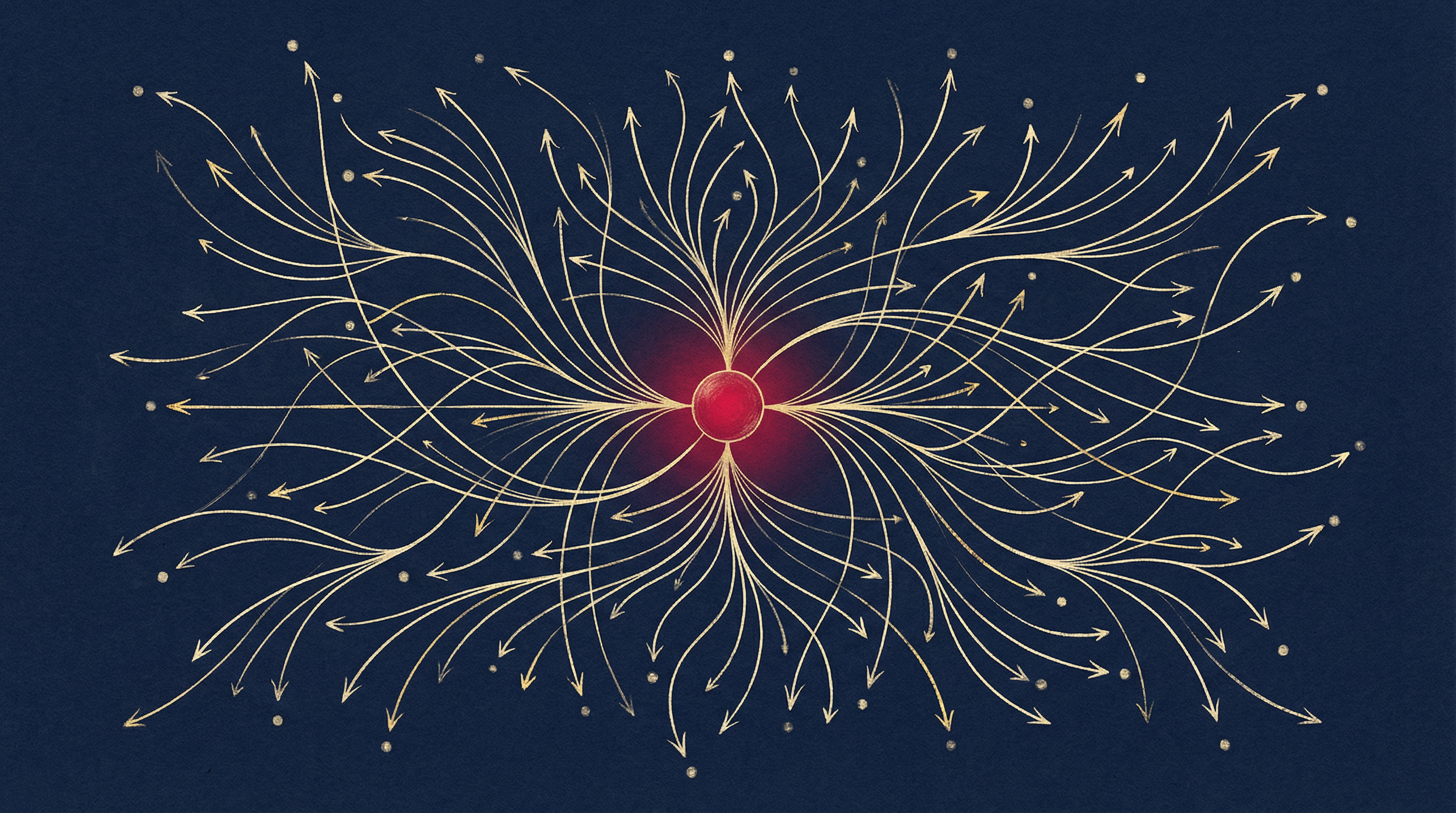
Force lines, radiating from a single point of want
A Study in Desire
"Man is the creature who does not know what to desire, and he turns to others in order to make up his mind." Rene Girard, Deceit, Desire, and the Novel, 1961
You know the feeling. Someone you follow buys something. You see the tweet. Your body moves before your brain finishes. Within sixty seconds you are reading a contract address you have never seen before with genuine interest. You tell yourself you are doing research. You are not doing research. You are watching someone else want something, and you are starting to want it too.
This is not a character flaw. This is the mechanism that René Girard spent his entire career documenting. He called it mimetic desire. His discovery was simple and it will not leave you once you understand it: we do not desire things on our own. We borrow our desires. We need a model. Someone whose desire we can observe. And then we replicate it. Not the object. The desire for the object.
Girard found this pattern in literature first. Then in history. Then in anthropology, in religion, in violence. Every time, the same structure appeared. The model desires. The disciple copies. The desire spreads. What looks like independent preference is actually an invisible web of mimetic chains, each person copying someone slightly above them in the hierarchy of perceived authority.
There is no original buyer. There is only the first person brave enough to want something out loud. Everyone else is downstream of that wanting. You have been downstream your entire time in this market. The question is not whether you imitate. The question is whose desire you are copying, and whether you know it.
Force lines, radiating from a single point of want
Think about the Caller. The account with eighty thousand followers who posts a contract address at nine in the evening. Within minutes, thousands of people who had never heard of this coin want it. Not because they analyzed the fundamentals. Because the model wants it. And when the model wants something, desire spreads faster than any chart pattern.
The Caller does not just move price. The Caller moves desire. And desire moves price. What looks like market discovery is actually a cascade of mimetic chains playing out in real time. One person's wanting becomes another's. That one becomes five. Those five become five hundred. The chart is a recording of desire spreading through a crowd. The order book is a map of who copied whom.
You have been rekt before. You bought the top. You felt it. That is not stupidity. That is what it feels like to be the last link in a mimetic chain. By the time desire reached you, the model had already started to exit. You bought the want. You paid for someone else's emotion. The dark humor you posted about it afterward was the only honest response available to you.
Girard also named what happens when the cascade reverses. When everyone wants the same thing, desire curdles into rivalry. The community that was building together starts tearing the project apart. The same mechanism that pumped it becomes the mechanism that destroys it. Girard saw this in ancient ritual sacrifice. You have seen it in every Telegram group that has ever flipped from bullish to blame within forty-eight hours.

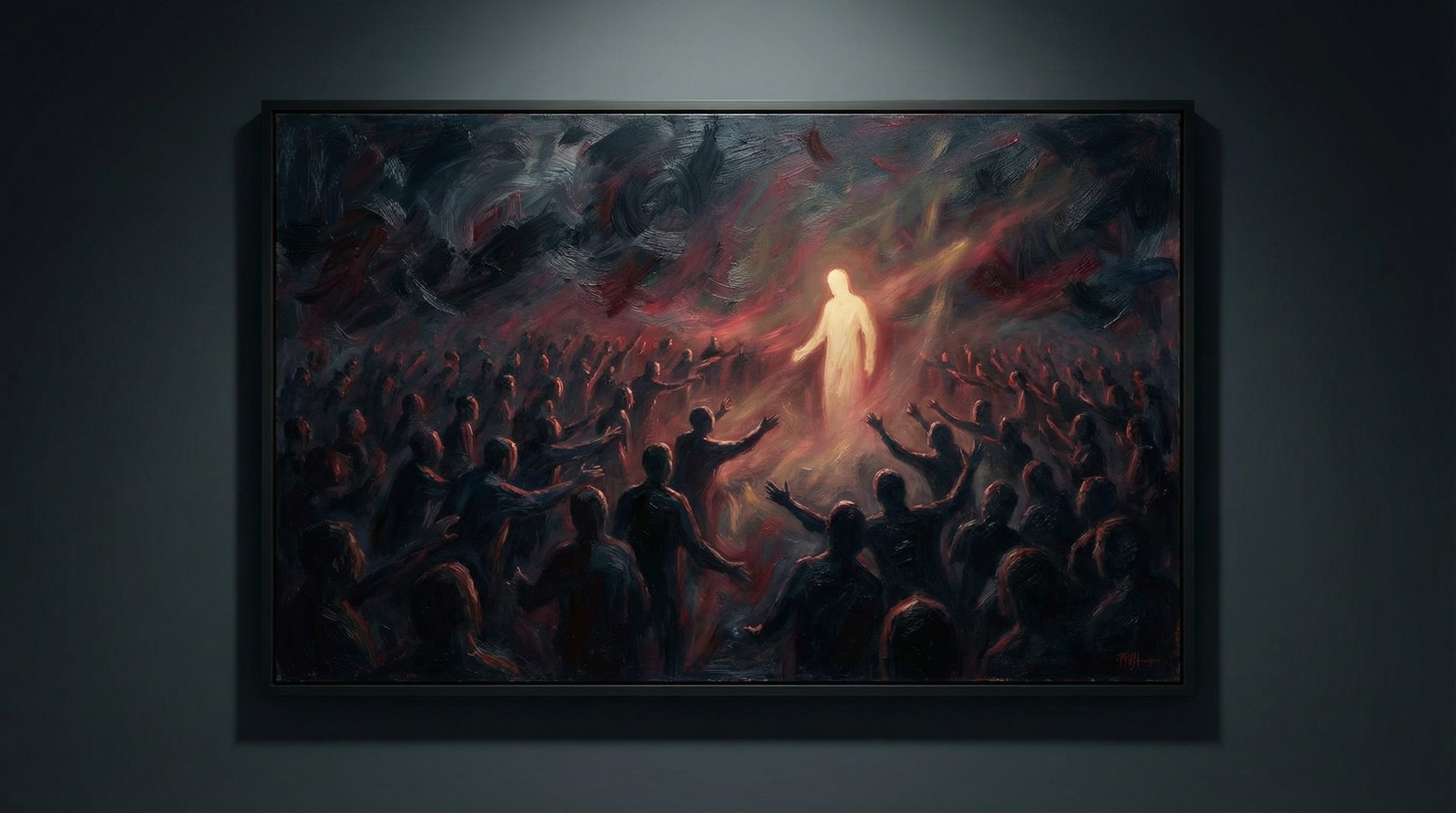
Awareness changes the game. Not completely. You will still feel the pull. But you will see it. You will be able to identify who is the model in a given moment. You will be able to locate yourself in the chain. You can enter with eyes open instead of swept away. That clarity is what Girard spent his life trying to give people. It is available to you now.
This project does not offer utility. It does not have a roadmap. It does not promise a product. It offers something rarer: an honest account of why every price moves. The price will go up if desire for it spreads. If it does not spread, the price will not go up. There is no mechanism beyond that. Every other project in this market has the same mechanic and lies about it. This one names it directly.
The coin IS the desire. Everyone who holds it knows exactly why they bought. Because others were buying. Because the desire reached them through someone they trust. That self-awareness is the only alpha available in a market where everyone is copying everyone and almost no one admits it. You are not buying a product. You are participating in the mechanism. Consciously. For the first time.
You did not decide to want what you want. A model decided first. You followed. This has been true every time. Acknowledging it does not make you weak. It makes you accurate.
Price discovery is mimetic propagation made visible. Every pump is Girard. Every crash is his theory's dark corollary. The chart is a map of desire, not of value.
Most people trade inside the cascade, unconscious of it. Awareness does not remove you from it. It changes your position inside it. That repositioning is the only real alpha.
Girard, René. Deceit, Desire, and the Novel: Self and Other in Literary Structure. Johns Hopkins University Press, 1965. Originally published in French as Mensonge romantique et vérité romanesque, 1961.
Girard, René. Violence and the Sacred. Johns Hopkins University Press, 1977. Originally published in French as La violence et le sacré, 1972.
Girard, René. Things Hidden Since the Foundation of the World. Stanford University Press, 1987. Originally published in French, 1978.
This project applies Girard's mimetic theory to contemporary crypto market dynamics. The philosophical framework is unchanged. Only the context is new.
Click to copy • Always verify contract address